
Clark County Court Records After Arrest
After a Clark County jail arrest, the booking record and the court record follow different paths. Jail records start with arrest, intake, booking charges, custody status, bond, and release or transfer. Court records start when the prosecutor files charges in an Indiana trial court. The Clark County Prosecuting Attorney represents the State of Indiana in felony and misdemeanor criminal prosecutions from crimes committed in Clark County. That filing decision is what turns a jail arrest into a court case.
For custody and booking facts, use Clark County jail inmate records. For booking photos, use the Clark County jail mugshots page. For filed charges, court dates, warrants, dispositions, and documents, use MyCase or the court/clerk. A jail charge can be amended, reduced, dismissed, or replaced by a prosecutor-filed charge, so the court record after an arrest is the better source for the case's legal status.
Find Clark County Court Records After Arrest
Indiana's public case-search path is MyCase. The MyCase help page says anyone may search for public, non-confidential case information and many documents are available online at no charge, although some older cases or documents may not be online. The MyCase landing page also states that official records of court proceedings may only be obtained directly from the court that maintains the record.
- Open Indiana MyCase and search by party name or case number.
- Use Clark County, court, case type, status, or date filters when available.
- Open the criminal case and review the charge list, events, hearings, and filings.
- Compare the court charge to any jail booking charge when the wording differs.
- Contact the clerk or court for official copies or documents that are not online.
The screenshot below is from the Indiana Courts MyCase search tool captured for Clark County court-record lookup.
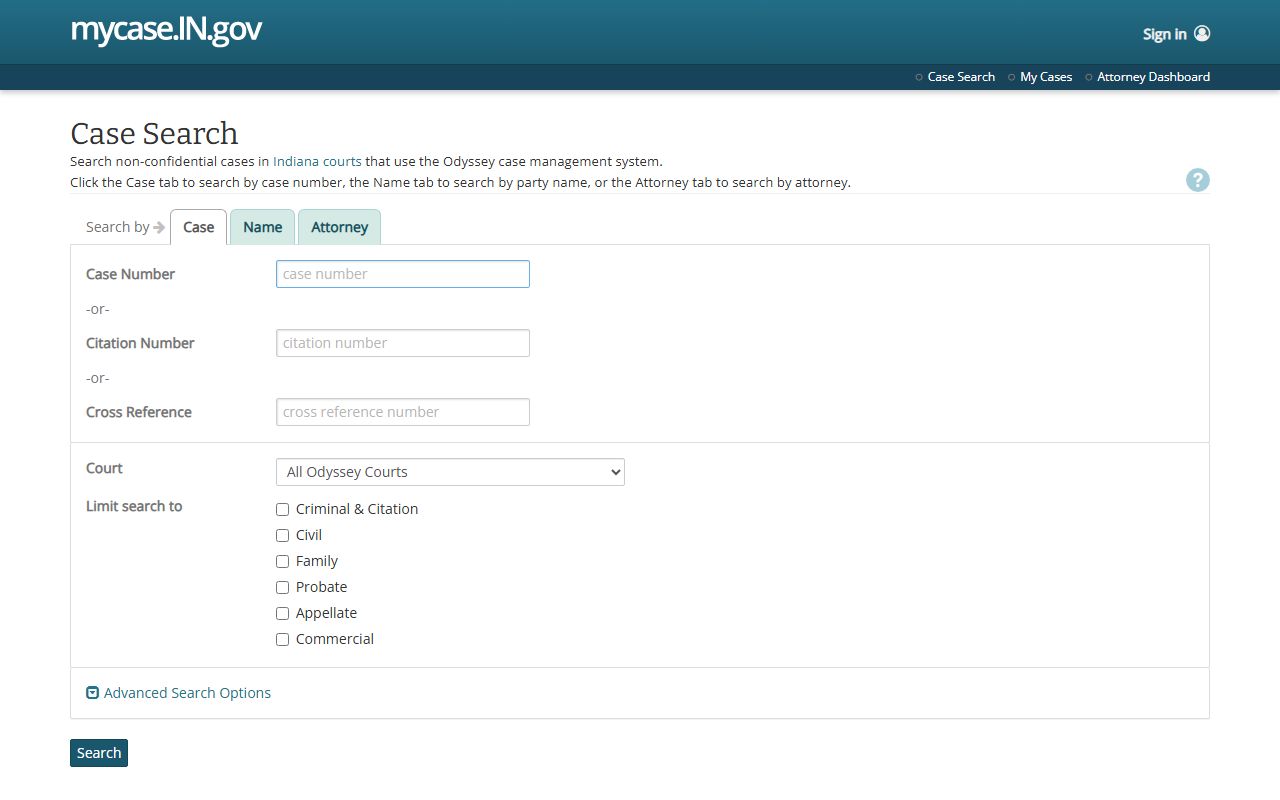
Use the court case result for filed-charge status and use the jail roster only for custody and booking status.
Charges Filed After a Clark County Arrest
The prosecutor decides what charges move forward in court. That filing can be based on police reports, arrest facts, warrant paperwork, investigation, or grand jury action. The research does not give a Clark-specific document-by-document fee table, so the practical route is MyCase first, then the Clark County Clerk or court for official copies.
| Document | Who Uses It | What It Does |
|---|---|---|
| Complaint | Prosecutor or officer-supported filing | States alleged facts and charge basis at the start of a case. |
| Information | Prosecutor | Formal charging document often used in Indiana criminal prosecutions. |
| Indictment | Grand jury process | Charges approved through a grand jury path in serious or selected matters. |
Clark County Charge Status Records
Charge status explains where the court case stands. It can change after the first filing. A charge may be pending, amended, reduced, dismissed, resolved by plea, resolved at trial, or tied to a warrant after failure to appear. A jail roster entry may keep the original booking charge while the court record shows a more current court charge or disposition.
| Status | What It Means |
|---|---|
| Pending | The charge is still active and has not reached final disposition. |
| Amended | The filed charge was changed by court filing or order. |
| Reduced | The charge level or offense was lowered, often through plea or amendment. |
| Dismissed | The charge is no longer being pursued in that case. |
| Disposed | The charge has a final result such as guilty, dismissed, acquitted, or another court outcome. |
Clark County Court and Prosecutor Contacts
The Clark County Clerk administers official trial-court records for cases within Clark County, prepares permanent historical records for the courts, and processes or issues court documents. The county courts are in the Clark County Government Building and Courthouse at 501 East Court Avenue in Jeffersonville. The court administrator listed in the research is R. Thomas Lowe, phone 812-207-2341. Prosecutor Jeremy Mull's office is in the Clark County Judicial Center, 501 E. Court Avenue, Room 215, with the criminal division at 812-285-6264.
Clark County Prosecuting Attorney
501 E. Court Avenue, Room 215
Jeffersonville, IN 47130
812-285-6264
Monday-Friday 8:30am-12:00pm and 1:00pm-4:30pm
Bond Records After Clark County Arrest
Bond sits between the jail record and the court case. The sheriff bond page says cash or surety and court cash bonds are collected 24 hours a day, seven days a week. During business hours, the sheriff prefers bonds be paid at the clerk's office. Cash-only bonds must be paid directly to the Clerk of Courts, and the clerk phone for bond is 812-285-6244. After court release, the sheriff FAQ says several jail processes occur before release, with an average wait of at least one hour and possibly longer.
| Bond Type | How It Works in Clark County Research |
|---|---|
| Cash bond | Money paid as required by court order; cash-only bonds go directly to the Clerk of Courts. |
| Surety bond | Bond posted through a surety or bail-bond process where allowed by the court. |
| Court cash bond | Listed separately on the sheriff bond page as collected 24/7. |
| No-bond or hold | A court order or agency hold may prevent release even when local bond issues are addressed. |
Warrants and Arrest Records
No official Clark County Sheriff active criminal warrant lookup was located in the sources reviewed. The sheriff's tax-warrant page is about Indiana Department of Revenue tax warrants and should not be treated as a criminal arrest-warrant list. Criminal bench warrants may appear through public court-case events in MyCase, or they may require contact with the court, clerk, sheriff, or an attorney. A records request can also seek arrest, summons, charge, or agency-response records when disclosure is allowed.
Note: Do not rely on the tax-warrant page to clear a criminal warrant. Contact the issuing court or counsel.
Charges vs Convictions
Being arrested or charged is not the same as being convicted. A charge is an accusation filed or listed in a jail or court record. A conviction is the final result after a guilty plea, trial verdict, or other adjudication. The difference matters for readers checking Clark County court records after a jail arrest because early records often show allegations that later change.
| Issue | Charge | Conviction |
|---|---|---|
| Stage | Accusation after arrest or filing | Final adjudication or plea result |
| Can Change | Yes, by amendment, reduction, or dismissal | Changed only through later court action |
| Where to Check | Jail roster and MyCase | MyCase and official court records |
Sealed and Expunged Court Records
Indiana expungement and sealing issues are handled under IC 35-38-9 and related court procedures. Eligible Indiana arrest or conviction records may be restricted through court action, but expungement does not automatically rewrite every public copy, private database, or third-party posting. The court record, sheriff record, and public roster may also have different update paths. For a Clark County case, use MyCase and the clerk for the court side and the sheriff records unit for sheriff-held booking or arrest records.
| Record Action | Plain Meaning | Limit |
|---|---|---|
| Sealed | Restricted from ordinary public view by court rule or order. | Some agencies may still have limited access. |
| Expunged | Restricted or marked under Indiana expungement law after eligibility and court action. | Does not guarantee every noncourt copy disappears. |
| Confidential | Withheld because another law protects it. | Juvenile, medical, security, or sealed material may not be public. |
Public Access Limits After Arrest
Indiana APRA, IC 5-14-3, supports public access to many records, while IC 5-14-3-4 describes confidential and discretionary exceptions. Clark County court records after arrest may be limited when a case is juvenile, sealed, expunged, confidential, or partly unavailable online. MyCase help also warns that some documents are not available online and that older cases may have limits. Official court records come from the court maintaining the record.
The MyCase help page captured below explains the public-access system and document limits for Indiana court records.
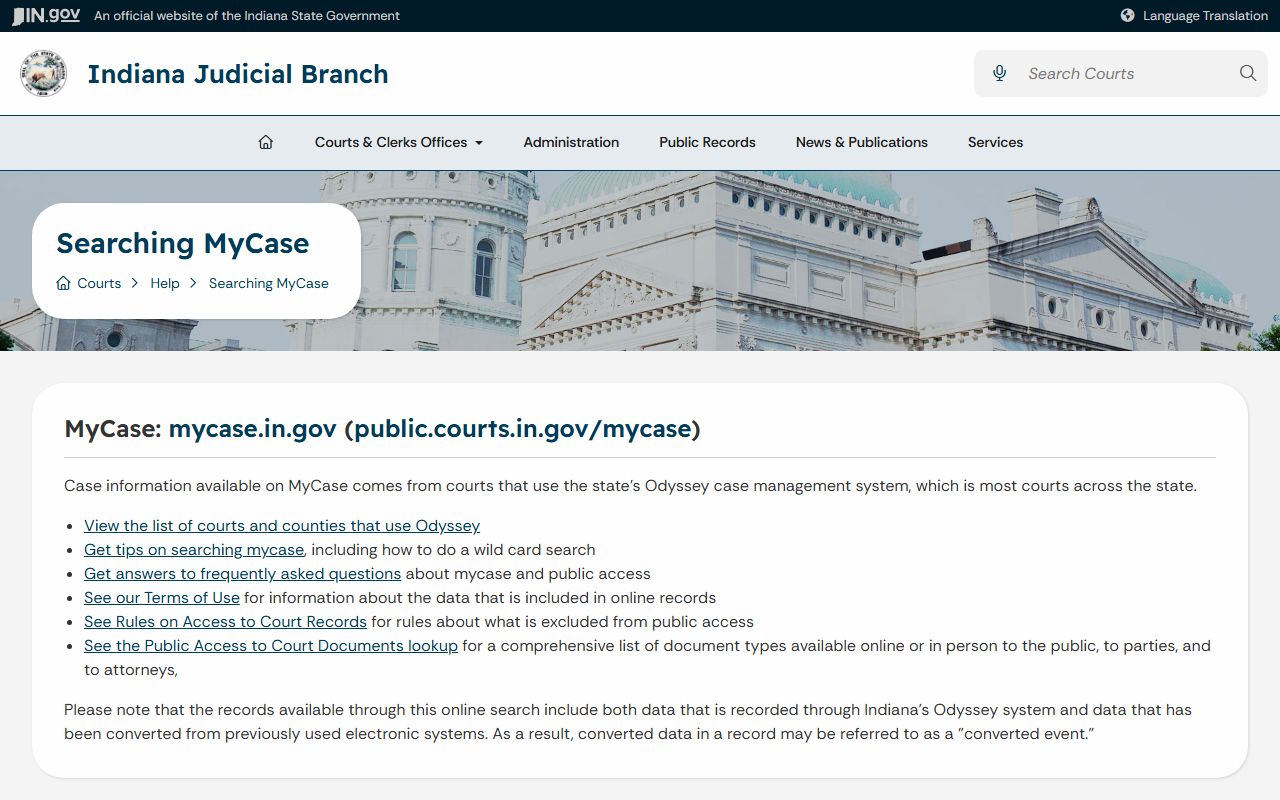
That distinction is important when a public search result shows a case but not every filing, order, or document image.